Dashboard Gallery

My approach is focused on understanding and responding to what is require, providing effective and practical solutions.

I design HR dashboards that cut through noise and surface the insights leaders actually need. From workforce planning to recruiting funnels to DEI and attrition trends, I build reporting ecosystems that are intuitive, scalable, and grounded in clean, reliable data. My dashboards don’t just visualize information—they clarify decisions, reveal patterns, and help HR teams operate with precision and confidence

Procurement Dashboards
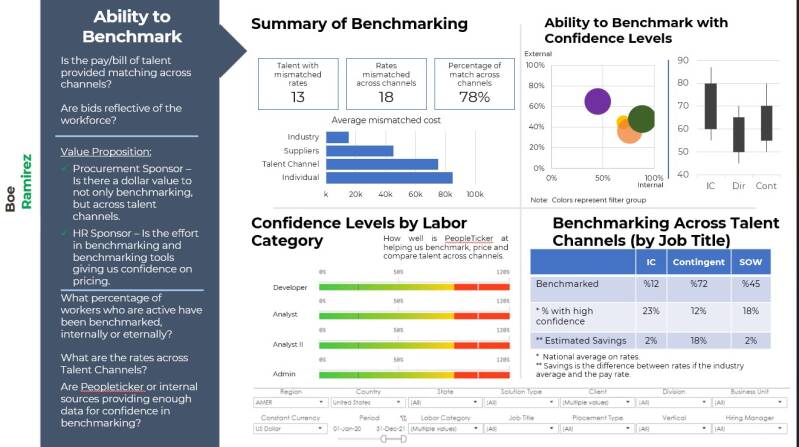
Ability to Benchmark

Is the pay/bill of talent provided matching across channels?

Are bids reflective of the workforce?

Value Proposition:

  • Procurement Sponsor –  Is there a dollar value to not only benchmarking, but across talent channels.
  • HR Sponsor – Is the effort in benchmarking and benchmarking tools giving us confidence on pricing.

Question

What percentage of workers who are active have been benchmarked, internally or eternally? 

What are the rates across Talent Channels?

Are Peopleticker or internal sources providing enough data for confidence in benchmarking? 

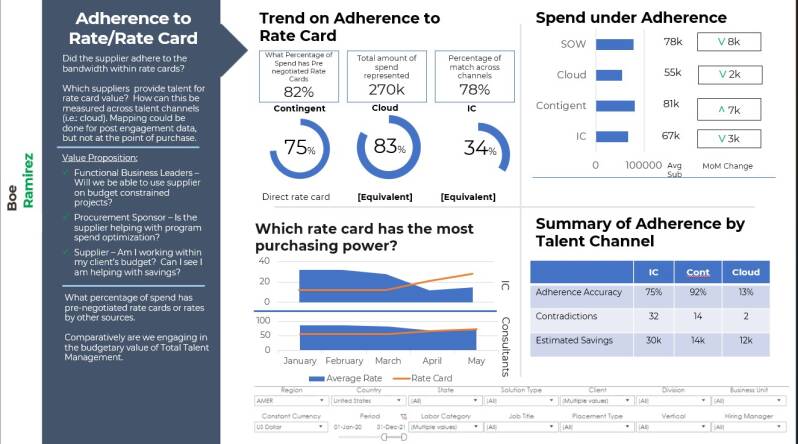
Adherence to Rate/Rate Card

Did the supplier adhere to the bandwidth within rate cards?

Which suppliers  provide talent for rate card value?  How can this be measured across talent channels (i.e.: cloud). Mapping could be done for post engagement data,

Value Proposition:

  • Functional Business Leaders – Will we be able to use supplier on budget constrained projects?
  • Procurement Sponsor – Is the supplier helping with program spend optimization?
  • Supplier – Am I working within my client’s budget?  Can I see I am helping with savings?

Question

What percentage of spend has pre-negotiated rate cards or rates by other sources. 

Comparatively are we engaging in the budgetary value of Total Talent Management.

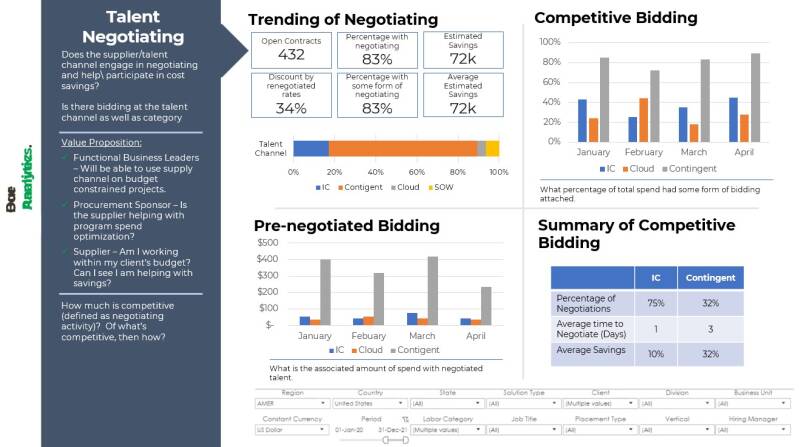
Talent Negotiating

Does the supplier/talent channel engage in negotiating and help\ participate in cost savings?

Is there bidding at the talent channel as well as category

Value Proposition:

  • Functional Business Leaders – Will be able to use supply channel on budget constrained projects.
  • Procurement Sponsor – Is the supplier helping with program spend optimization?
  • Supplier – Am I working within my client's budget?  Can I see I am helping with savings?

Question

How much is competitive (defined as negotiating activity)?  Of what’s competitive, then how?

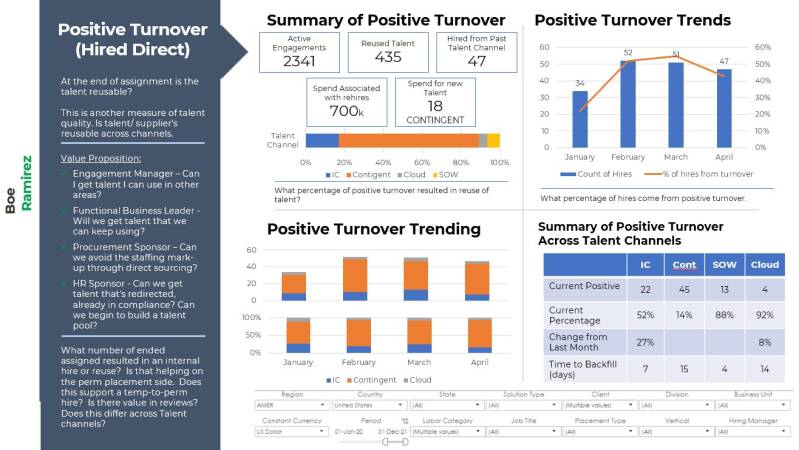
Positive Turnover (Hired Direct)

At the end of assignment is the talent reusable?

This is another measure of talent quality. Is talent/ supplier's reusable across channels.

Value Proposition:

  • Engagement Manager – Can I get talent I can use in other areas?
  • Functional Business Leader - Will we get talent that we can keep using?
  • Procurement Sponsor – Can we avoid the staffing mark-up through direct sourcing?
  • HR Sponsor - Can we get talent that's redirected, already in compliance? Can we begin to build a talent pool?

Question

What number of ended assigned resulted in an internal hire or reuse?  Is that helping on the perm placement side.  Does this support a temp-to-perm hire?  Is there value in reviews?   Does this differ across Talent channels?

Adherence to Rate/Rate Card

Did the supplier adhere to the bandwidth within rate cards?

Which suppliers  provide talent for rate card value?  How can this be measured across talent channels (i.e.: cloud). Mapping could be done for post engagement data, but not at the point of purchase.

Value Proposition:

  • Functional Business Leaders – Will we be able to use supplier on budget constrained projects?
  • Procurement Sponsor – Is the supplier helping with program spend optimization?
  • Supplier – Am I working within my client’s budget?  Can I see I am helping with savings?

Question

What percentage of spend has pre-negotiated rate cards or rates by other sources. 

Comparatively are we engaging in the budgetary value of Total Talent Management.

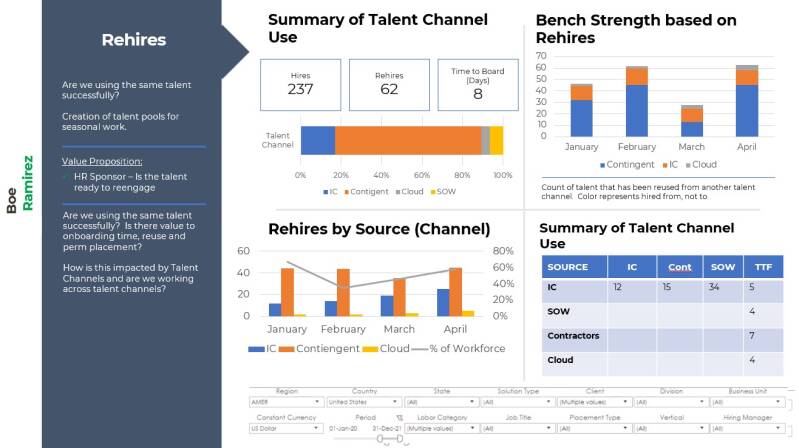
Rehires

Are we using the same talent successfully?

Creation of talent pools for seasonal work.

Value Proposition:

  • HR Sponsor – Is the talent ready to reengage

Question

Are we using the same talent successfully?  Is there value to onboarding time, reuse and perm placement?

How is this impacted by Talent Channels and are we working across talent channels?

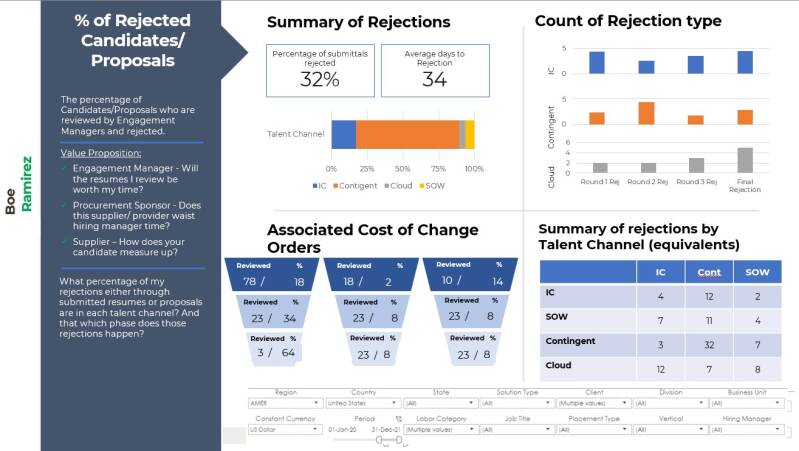
% of Rejected Candidates/ Proposals

The percentage of Candidates/Proposals who are reviewed by Engagement Managers and rejected.

Value Proposition:

  • Engagement Manager - Will the resumes I review be worth my time?
  • Procurement Sponsor - Does this supplier/ provider waist hiring manager time?
  • Supplier – How does your candidate measure up?

Question

What percentage of my rejections either through submitted resumes or proposals are in each talent channel? And that which phase does those rejections happen?

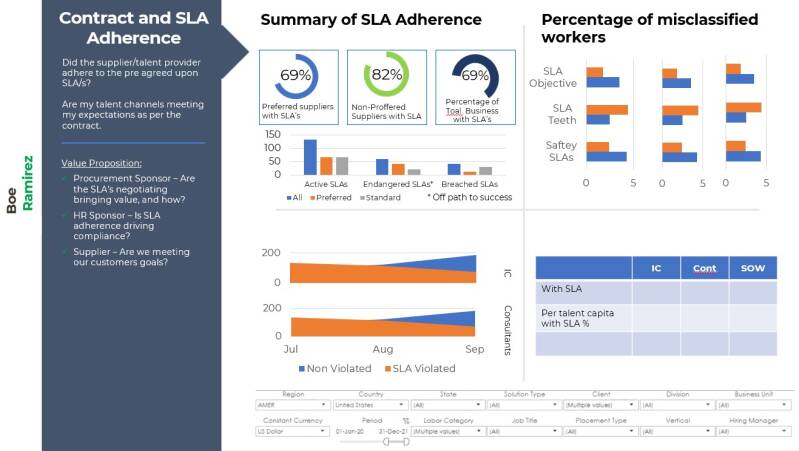
Contract and SLA Adherence

Did the supplier/talent provider adhere to the pre agreed upon SLA/s?

Are my talent channels meeting my expectations as per the contract.

Value Proposition:

  • Procurement Sponsor – Are the SLA’s negotiating bringing value, and how?
  • HR Sponsor – Is SLA adherence driving compliance?
  • Supplier – Are we meeting our customers goals?

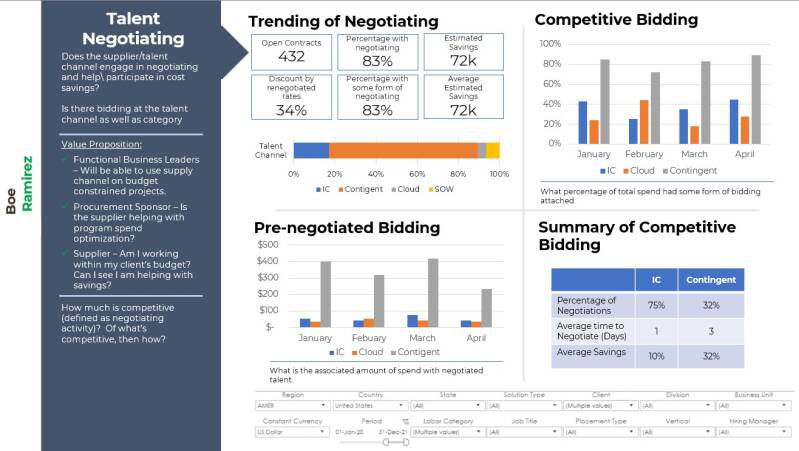
Talent Negotiating

Does the supplier/talent channel engage in negotiating and help\ participate in cost savings?

Is there bidding at the talent channel as well as category

Value Proposition:

  • Functional Business Leaders – Will be able to use supply channel on budget constrained projects.
  • Procurement Sponsor – Is the supplier helping with program spend optimization?
  • Supplier – Am I working within my client's budget?  Can I see I am helping with savings?

Question

How much is competitive (defined as negotiating activity)?  Of what’s competitive, then how?

Other HR Dashboards and Tools

Recruiter Dashboard

What should I work on today? (e.g., pending tasks, overdue screenings).

Value Proposition:

  • What should I work on today? (e.g., pending tasks, overdue screenings).

Question

  • Enhanced Efficiency & Productivity: Eliminates time-consuming manual data compilation, allowing recruiters to focus on candidate engagement.
  • Data-Driven Decision Making: Enables, as discussed in this Reddit post, better, faster, and more accurate hiring decisions.
  • Proactive Bottleneck Identification: Highlights bottlenecks early by tracking stage-by-stage candidate flow and interview scheduling.
  • Improved Stakeholder Communication: Provides a clear, transparent view of hiring progress for hiring managers and executives, reducing manual status updates.
  • Strategic Optimization: Helps analyze, according to this Oleeo article, which channels produce the best talent to lower cost-per-hire and optimize sourcing strategies.

Create Your Own Website With Webador