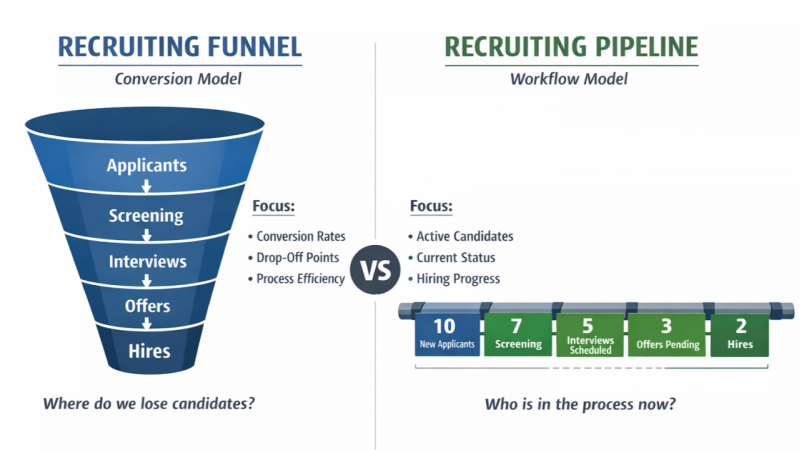
Throughout my career, I've run into many requests for a candidate pipeline and what I've found is that the expectation was a candidate funnel. Here’s the cleanest way to understand it: a recruiting funnel describes how candidates narrow down through stages (a conversion model), while a recruiting pipeline describes the active candidates currently in motion (a workflow model). They’re related, but they answer completely different questions.
Most organizations blur the line between a recruiting funnel and a recruiting pipeline—and that’s exactly why reporting gets messy. These two models serve different executive needs, and understanding the difference is key to better hiring decisions.
What Is a Recruiting Funnel?
A recruiting funnel is a conversion model—borrowed from marketing—that shows how candidates move from one stage to the next.
Think of it as math + pattern recognition.
It answers:
- How many applicants you need to make one hire
- Where candidates drop off
- Whether your process is improving or deteriorating
- How efficient each stage is
It’s historical or aggregate—not real-time.
What Is a Recruiting Pipeline?
A recruiting pipeline is the live set of candidates currently moving through your hiring process.
Think of it as your real-time traffic report.
It answers:
- Who is interviewing today
- Who is waiting on feedback
- Whether you have enough candidates to hit hiring goals
- Which roles are at risk due to low volume
It’s operational and real-time—not historical.
The Fastest Way to Tell Them Apart
If it shows conversion rates, it’s a funnel. If it shows active candidates, it’s a pipeline.
Why This Distinction Matters (Especially for People Analytics)
Each model serves a different executive need:
Diagnostic Checklist
You’re Looking at a Recruiting Funnel If It Answers:
- “How many applicants do we need to make one hire?”
- “Where are candidates dropping off?”
- “What’s our conversion rate from screening to interview?”
- “How does our time-to-fill compare across departments?”
Traits: Historical, aggregate, conversion-focused
You’re Looking at a Recruiting Pipeline If It Answers:
- “Who is interviewing this week?”
- “How many candidates are in final rounds?”
- “Do we have enough candidates for this role?”
- “Which roles have stalled or need sourcing?”
Traits: Real-time, operational, candidate-status-focused
Add comment
Comments